
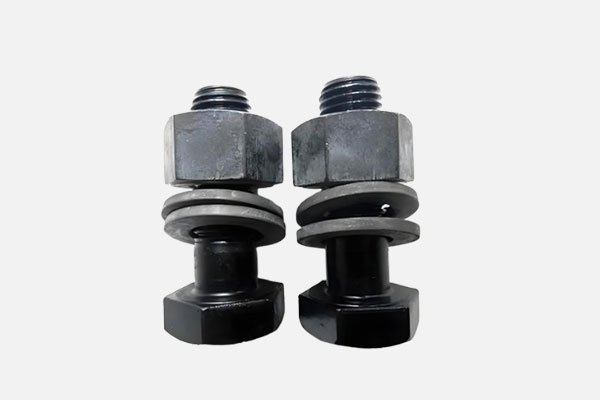
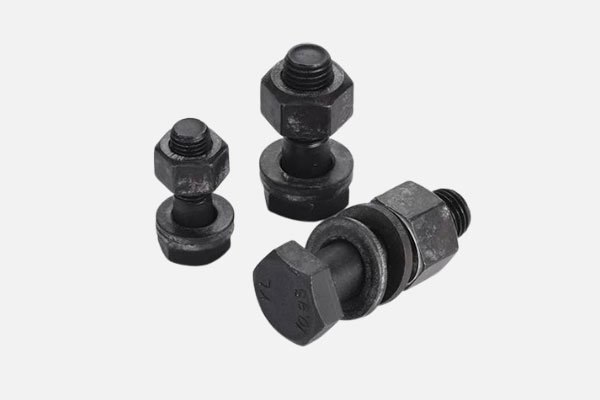
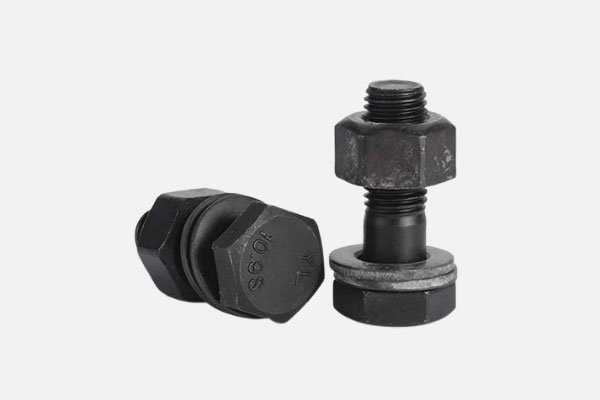
10.9S Large Hexagonal Structural Bolts
Meaning of the Markings
10: Nominal tensile strength grade of 1000 MPa;
9: Yield-to-tensile strength ratio of 0.9;
S: For steel structures only;
Complete fastening set: 1 bolt + 1 nut + 2 washers. These must be used as a complete set from the same batch; mixing components from different batches is strictly prohibited.
Production Process
Raw material spheroidisation annealing → Cold heading → Thread rolling → Quenching + high-temperature tempering (tempering to achieve strength and toughness) → Dehydrogenation treatment (to prevent hydrogen embrittlement) → Surface treatment → Torque coefficient testing → Packaging in sets.
Construction Techniques
Tightening Procedure: Initial tightening + Re-tightening + Final tightening
Initial tightening: 50% of the final tightening torque, to eliminate gaps between panels; for large numbers of joints, re-tightening should be carried out;
Tightening sequence: Tighten symmetrically from the centre of the joint outwards; tightening from the edges towards the centre is prohibited to prevent panel warping and residual gaps.
Washer installation orientation
Bolt head side: The chamfered face of the washer faces the bolt head; nut side: The chamfered face of the washer faces the conical surface of the nut; incorrect orientation will result in severe inaccuracies in the torque coefficient (Douyin Encyclopedia).
Tool management
Torque wrenches must be calibrated prior to use; re-inspection must be carried out before the start of each shift; the error margin of torque wrenches must not exceed ±5 per cent.
Validity period of torque coefficients
The factory-guaranteed validity period for torque coefficients is six months; beyond this period, they must be re-tested; they must not be used directly if they have become damp, exposed to rain or rusted.
Final Tightening Inspection
Torque spot checks must be carried out between 1 hour and 24 hours after final tightening is completed; 10 per cent of the bolts, with a minimum of 20 sets, must be inspected; under-tightened bolts must be retightened, whilst over-tightened bolts must be replaced; re-tightening for rectification is strictly prohibited.
Common Failure Modes
- Hydrogen embrittlement fracture: Most typical in hot-dip galvanised bolts; the fracture surface is brittle, with no obvious plastic deformation; root cause: insufficient hydrogen removal following electroplating or hot-dip galvanising.
- Under-tightening (insufficient preload): Torque wrench not calibrated; failure to perform initial tightening followed by retightening; joint slippage; insufficient load-bearing capacity.
- Overtightening: Excessive torque causes the bolt to yield plastically, resulting in direct and permanent damage; bolts that have been overtightened must be scrapped and replaced; they cannot be retightened to rectify the issue.
- Excessive variation in torque coefficients: Washers fitted the wrong way round; rust caused by knocks to the threads; mixing of different batches; exposure to moisture during storage.
- Gaps between plates not eliminated: Incorrect tightening sequence resulting in internal gaps, creating a false impression of higher actual preload.
- Incorrect length selection: Insufficient exposed thread length, or threads extending into the shear plane, significantly reducing shear resistance.
Procurement and Warehousing
Complete connection sets must be procured; bolts, nuts and washers must not be purchased separately and assembled independently.
Store in a warehouse protected from damp and rain, and stack in sealed containers; direct stacking on the ground outdoors is strictly prohibited; for batches affected by damp or rust, retest the torque coefficient and scrap any non-compliant items.
Store items separately by batch and label them clearly to prevent mixing of batches.
Do not substitute standard Grade 10.9 mechanical bolts for Grade 10.9S bolts in the main joints of steel structures, as this poses a significant safety hazard.