
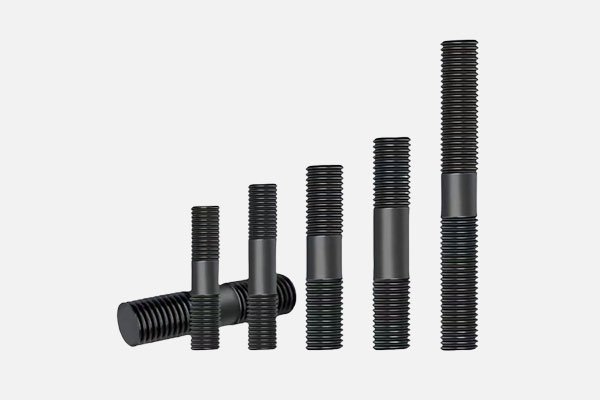
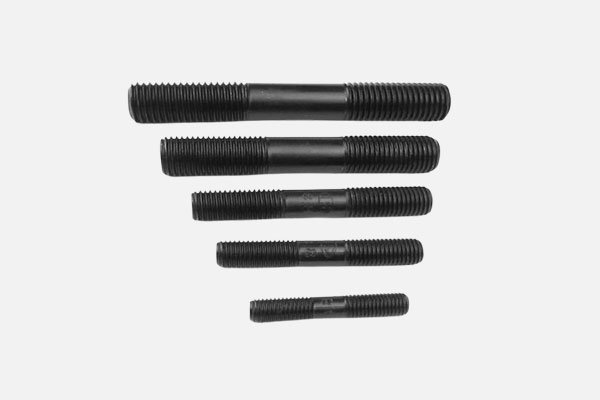
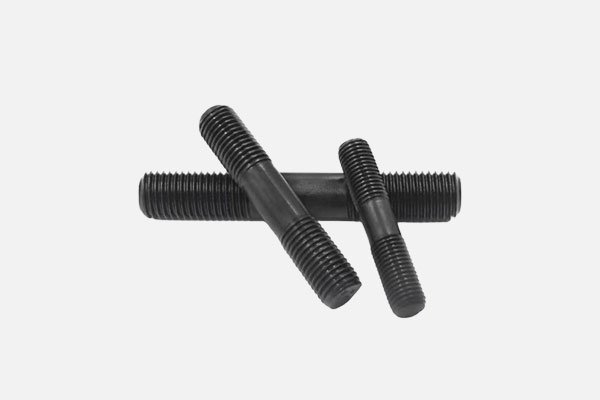
High Strength Double Ended Bolts
Material and Process : Typically made from medium-carbon steel or alloy steel, subjected to quenching and tempering heat treatment
Properties : High tensile and yield strengths; excellent load-bearing, vibration-resistant and anti-loosening properties
Compatibility: To be used with high-strength nuts of the same strength grade; typically used in conjunction with flat washers and spring washers
Product Description
High strength double ended bolts refer to specialised fasteners of grade 8.8 and above (8.8, 10.9, 12.9) with threads at both ends and a smooth shank in the middle. They rely on matching nuts at both ends to achieve a clamped connection between two components. As they are required to withstand heavy loads, alternating vibrations and high-pressure loads, they undergo specialised quenching and tempering heat treatment and are widely used in critical areas such as steel structures, pressure vessels, construction machinery and pipe flanges.
Performance grade
- Grade 8.8: The first digit, 8, denotes a minimum tensile strength of ≥800 MPa; the second digit, 8, denotes a yield-to-tensile strength ratio of 0.8, resulting in a minimum yield strength of 800 × 0.8 = 640 MPa. The raw material is typically high-quality 45# medium-carbon steel, which undergoes quenching and high-temperature tempering. This is the most cost-effective general-purpose high-strength grade.
- Grade 10.9: Tensile strength ≥ 1040 MPa, yield-to-tensile ratio 0.9, with a yield strength of up to 936 MPa. The base material is typically 40Cr chromium alloy steel, offering excellent comprehensive tensile, shear and fatigue resistance. It is commonly used for medium- and high-pressure flanges and heavy-duty equipment.
- Grade 12.9: The top-tier grade in the high-strength series, with a tensile strength of ≥1220 MPa, a yield-to-tensile ratio of 0.9, and a yield strength of 1098 MPa. It utilises high-quality alloy steels such as 35CrMo and is suitable for harsh operating conditions involving high temperatures, high pressure and severe vibration.
Selection and Installation
Grade matching: Grade 8.8 bolts must be used with Grade 8 nuts, and Grade 10.9 bolts with Grade 10 nuts. Mixing different grades is strictly prohibited, as this may lead to fastening failure;
Installation guidelines: For heavy-duty flange connections, a torque wrench must be used to tighten the bolts evenly in stages. Do not tighten one side forcefully to prevent stress fractures in the studs; In vibrating conditions, spring washers or lock nuts may be fitted;
Environmental Selection: For dry indoor environments, black oxide or electro-galvanised finishes may be selected; for damp outdoor environments, hot-dip galvanised finishes should be chosen; in coastal or chemical corrosive environments, Darco or 304/316 stainless steel materials are recommended.
Applications
High strength double ended bolts are commonly used for removable connections in heavy-load and vibration-prone applications, such as pressure vessels, pipe flanges, steel structures, construction machinery, locomotives and high-pressure equipment
Petrochemical Piping and Pressure Vessels
Flanged connections for various oil, gas and chemical pipelines; grades 10.9 and 12.9 are the preferred choice for high-temperature and high-pressure environments;
Steel Structure Engineering
Steel structures for industrial buildings, bridge embedded parts and bracket anchoring; grades 8.8 and 10.9 are the most widely used;
New energy sector
Fastening of wind turbine tower components and large-scale photovoltaic mounting bases; hot-dip galvanised high-strength double-ended studs are frequently selected for outdoor environments;
Construction machinery and mining equipment
Connections for engine blocks, frames and hydraulic components; due to prolonged exposure to vibration loads, quenched and tempered high-strength studs must be used;