
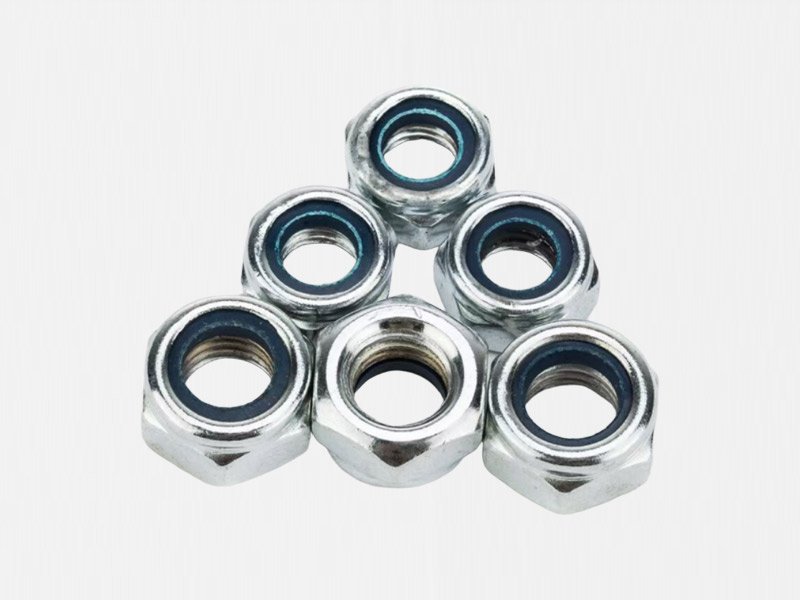
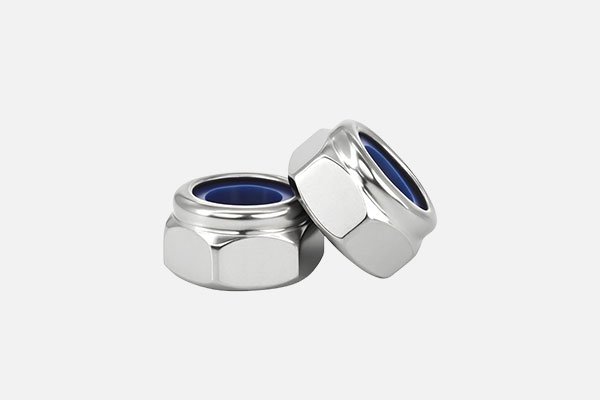
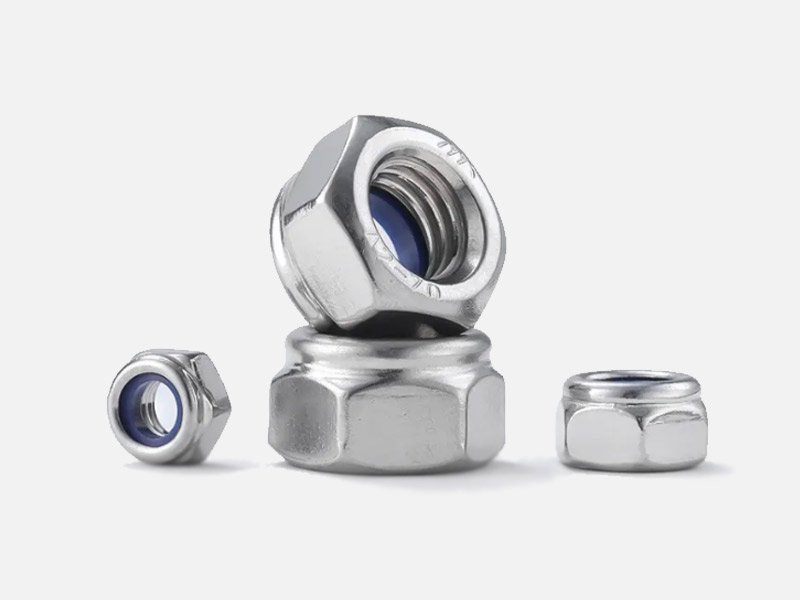
Grade 4 Nylon Lock Nuts
Material: Q235 carbon steel
Strength Grade: Grade 4
Surface Treatment: Electro-galvanized
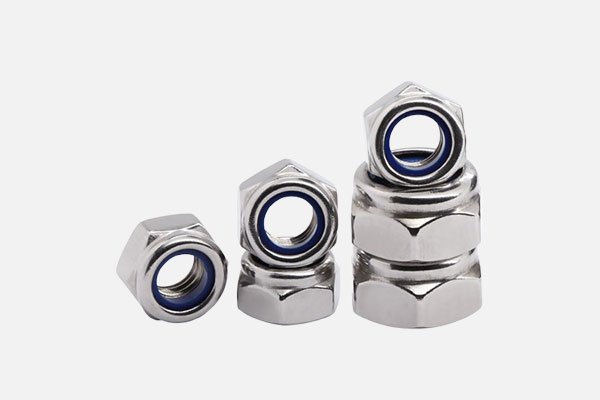
Thread Specifications: M5, M8, M10, M16, M18, M24 (standard stock, all compliant with DIN 985)
Product Description
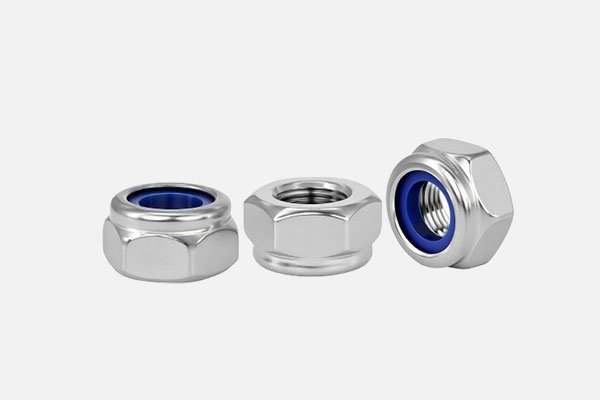
A Grade 4 nylon lock nut is a hex nut with an embedded nylon ring; the ‘Grade 4’ denotes its strength grade. Its key advantage lies in the interference fit between the nylon ring and the bolt threads, which provides a self-locking mechanism to prevent loosening. It is suitable for general fastening applications involving low to medium loads and vibrating conditions.
Core structure: Standard hexagonal nut + embedded nylon ring at the top (without pre-formed threads); as the bolt is tightened, the threads cut into the nylon to create an elastic clamping force.
Anti-loosening principle: The compression of the nylon ring generates prevailing torque, which prevents the nut from loosening due to vibration, impact or temperature changes through friction.
Appearance: Hexagonal body, with a black or white nylon ring visible at one end; no specific grade marking (Grade 4 is typically unmarked).
Product Features
|
Basic anti-loosening |
Suitable for general vibration environments; no additional anti-loosening measures (such as spring washers or threadlocker) are required. |
|
Easy installation |
Can be fitted using a standard spanner; no special tools required. |
|
Reusability |
The nylon ring offers good elasticity and retains its anti-loosening performance after 3–5 cycles of assembly and disassembly (depending on operating conditions). |
|
Cost advantage |
Grade 4 is an entry-level anti-loosening nut, offering excellent value for money and suitable for general-purpose bulk applications. |
|
Limitations |
Operating temperature ≤ 80°C (nylon softening temperature); not suitable for high-strength or high-temperature applications. |
Installation and Use
Application Scenarios
- General machinery: non-critical components such as small motors, pumps and valves, fans, and conveyor belts.
- Electronics and electrical equipment: securing distribution boards, control cabinets, and instruments and gauges.
- Furniture and household appliances: domestic appliances with low vibration levels, such as washing machines, air conditioners and fitness equipment.
- Automotive parts: interior trim, non-load-bearing chassis components, and securing vehicle lights.
- Building and decoration: door and window fittings, railings, and connections in light steel structures.
Manufacturers of fasteners at source
We are a leading manufacturer with many years of experience in the fastener industry, specialising in a wide range of fasteners for industrial, construction and mechanical applications. We offer a comprehensive range of specifications and models, covering numerous commonly used standard parts, providing a one-stop solution for all your procurement needs.