Are 10.9 Bolts Stronger than Grade 8.8?
In mechanical fastening, Grade 10.9 and Grade 8.8 bolts are the two most widely used grades, and many people wonder which of the two is stronger. From a technical perspective, it is important to clarify the core meaning of ‘strength’—the strength of a bolt primarily depends on key performance indicators such as tensile strength and yield strength. Grade 10.9 bolts outperform Grade 8.8 bolts in these core metrics; therefore, Grade 10.9 bolts are stronger than Grade 8.8 bolts.
To determine whether a bolt is secure, the key lies in two critical indicators: tensile strength and yield strength; the bolt grade designation corresponds directly to these parameters. In the case of a 10.9-grade bolt, the ‘10’ indicates that the minimum tensile strength is 1040 MPa, the ‘9’ indicates that the ratio of yield strength to tensile strength is 0.9, meaning the minimum yield strength is 940 MPa; whereas the ‘8’ in Grade 8.8 denotes a minimum tensile strength of 800 MPa, and the ‘8’ after the decimal point indicates a ratio of 0.8, corresponding to a minimum yield strength of 640 MPa. Compared to Grade 10.9 bolts, Grade 8.8 bolts have slightly lower strength but offer better value for money. They are capable of meeting the connection requirements for most medium-load applications and are a widely used bolt grade in industrial production.
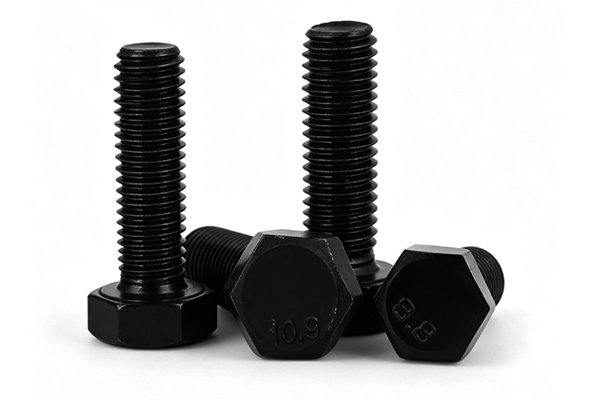
In terms of material and manufacturing process, Grade 10.9 bolts are made from high-quality alloy structural steel and undergo rigorous quenching and tempering heat treatment, ensuring the steel combines high strength with good toughness and prevents brittle fracture; Grade 8.8 bolts are typically made from medium-carbon steel or low-alloy steel, with a relatively simple heat treatment process. These differences in material and manufacturing process give Grade 10.9 bolts a distinct advantage in terms of strength.
It is important to note that ‘stronger’ does not necessarily mean ‘suitable for all applications’. Although Grade 10.9 bolts offer superior performance, they are more expensive and require more complex machining processes. Using them in ordinary, low-load applications would result in unnecessary costs; furthermore, due to their high hardness, torque must be carefully controlled during installation to prevent thread damage. Grade 8.8 bolts offer good value for money and are suitable for medium-load applications. When selecting bolts, one should make a reasonable choice based on the specific load requirements and operating environment of the application, whilst taking cost factors into account, to ensure both connection safety and the avoidance of resource wastage.